Transmitted Flux Power Spectra - Binning by Median Optical Depth
Overview
The primary motivation for this study is that we would like to use Cholla to study the expansion histories of different cosmologies. Comparing the transmitted flux power spectra won’t be effective, as cosmologies may have pass differently before reionization impacts the intergalactic medium at a particular redshift. Instead, a probe we use to compare the expansion histories of different cosmologies is by grouping the transmitted flux power spectra by the median/effective optical depth of each skewer.
The goal of this study is to see whether this probe of distinguishing flux power spectra can show any cool relationships.
The code to generate this study is found here.
This study was calculated on lux and the outputs can be found /data/groups/comp-astro/digarza/fluxpowspec_optdepthstack/.
To study these effects with respect to resolution and skewer count, we run a total of 2 \(L=50 h^{-1} \rm{Mpc}\) simulations with the same Planck 2018 cosmology:
\(512^3\) cells & lya_skewers_stride=4 \(\rightarrow 49152\) skewers
\(1024^3\) cells & lya_skewers_stride=4 \(\rightarrow 196608\) skewers
We set skewer outputs at the following redshifts: 10. , 9.5 , 9. , 8.5 , 8. , 7.5 , 7. , 6.5 , 6. , 5.5 , 5. , 4.5 , 4. , 3.5 , 3. , 2.5 , 2. , 1.5 , 1. , 0.95, 0.75, 0.5 , 0.25, 0.15, 0.1 , 0.05.
Quantile Approach
We assume that we have 3 key pieces of information:
Lower bound of the median optical depth
Upper bound of the median optical depth
Number of Quantiles
Given some skewer directory and a list of output skewer files to look at, the general flow of the code is as follows:
Sort all effective optical depths
Clip away effective optical depths outside provided bounds
Calculate the number of skewers in each quantile (roughly the same in each)
Create array with information to index into local optical depth calculation in skewer files for each quantile
Calculate the mean of the local fluxes for each quantile
Calculate the \(k\)-modes along each axis
Grab the local optical depth and calculate the flux power spectra along each axis for each quantile
Profit
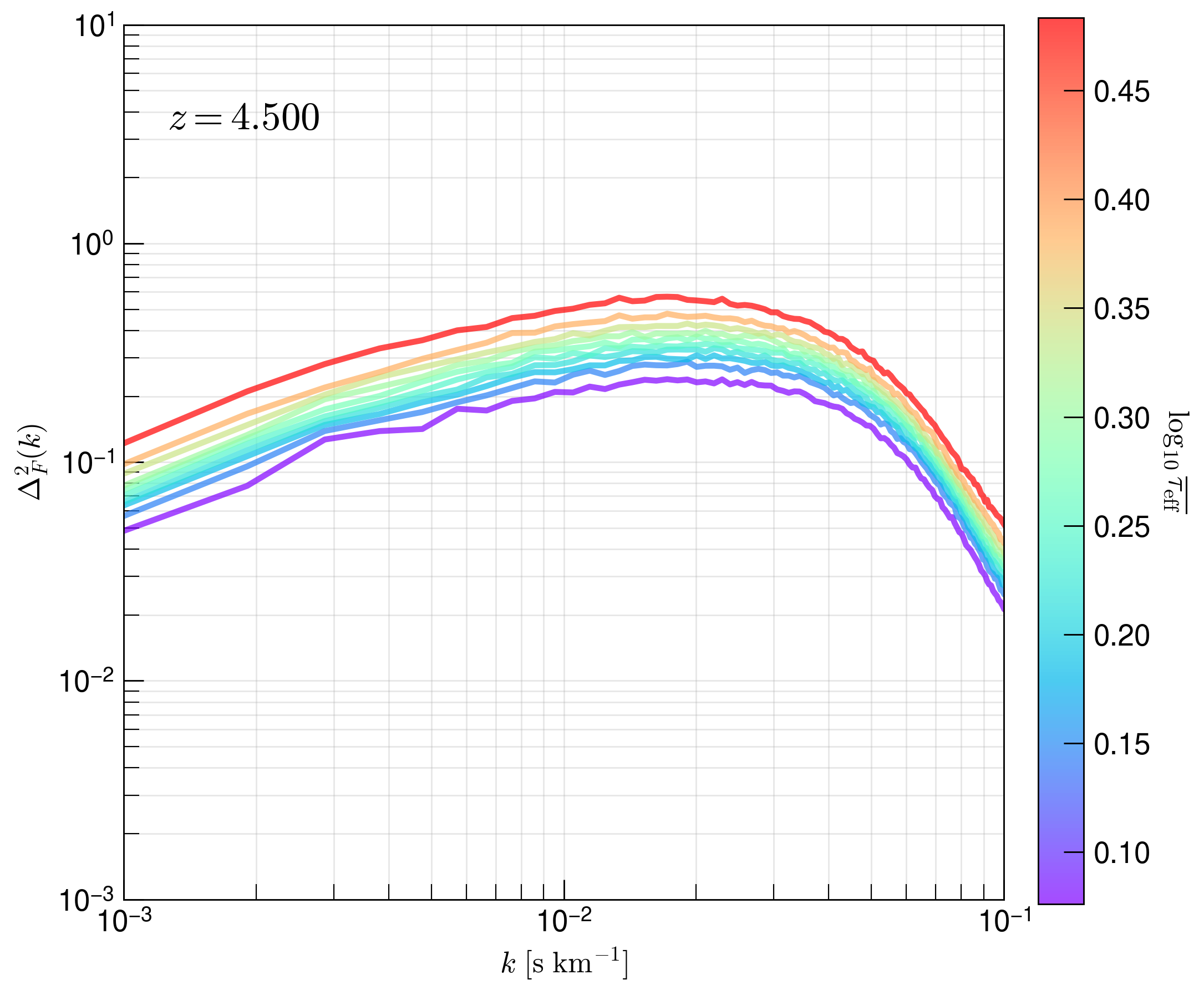
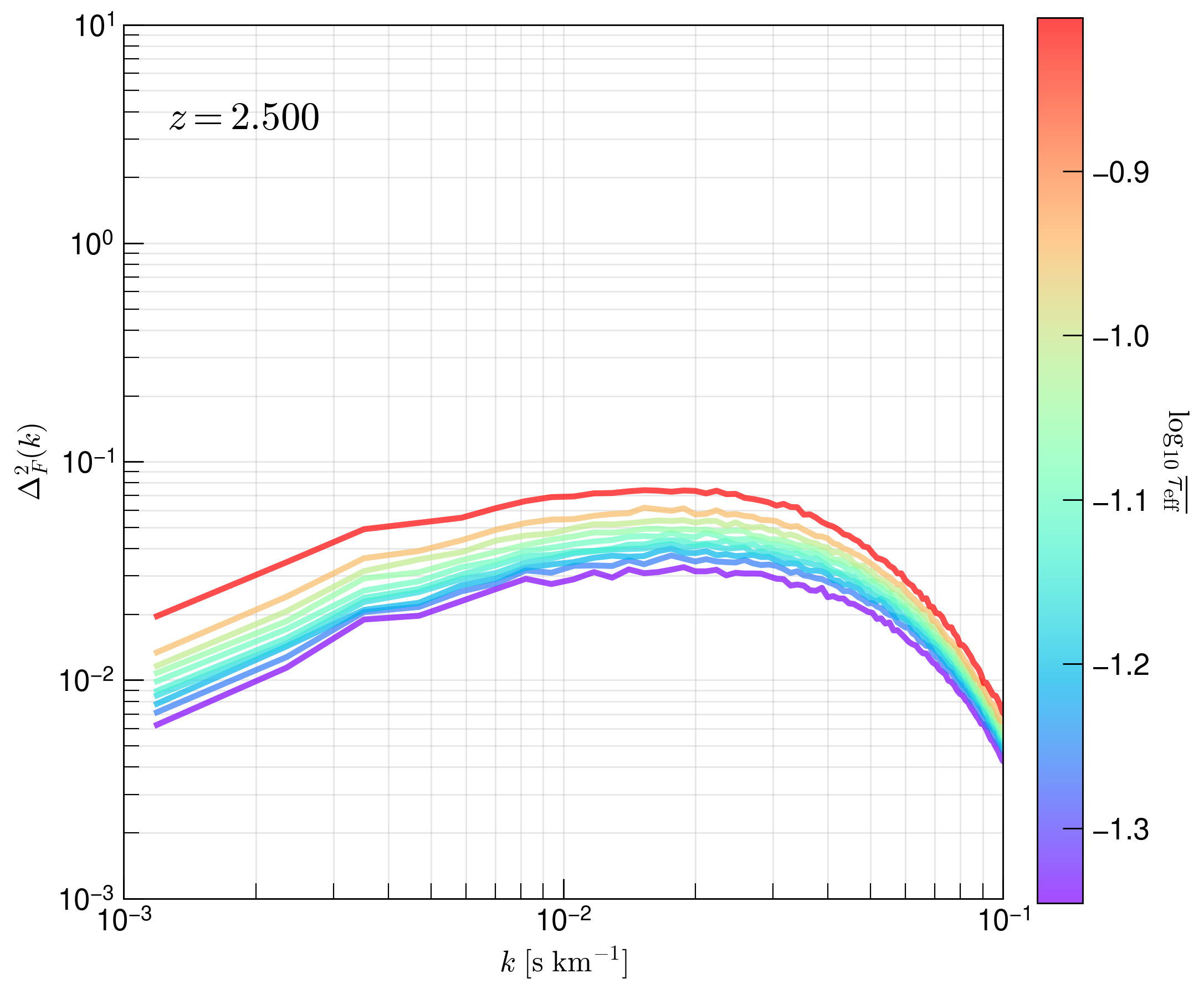
Simulation 1 Results – \(512^3\) cells
We show the resulting plots at redshifts \(z=2.5, 4.5\)
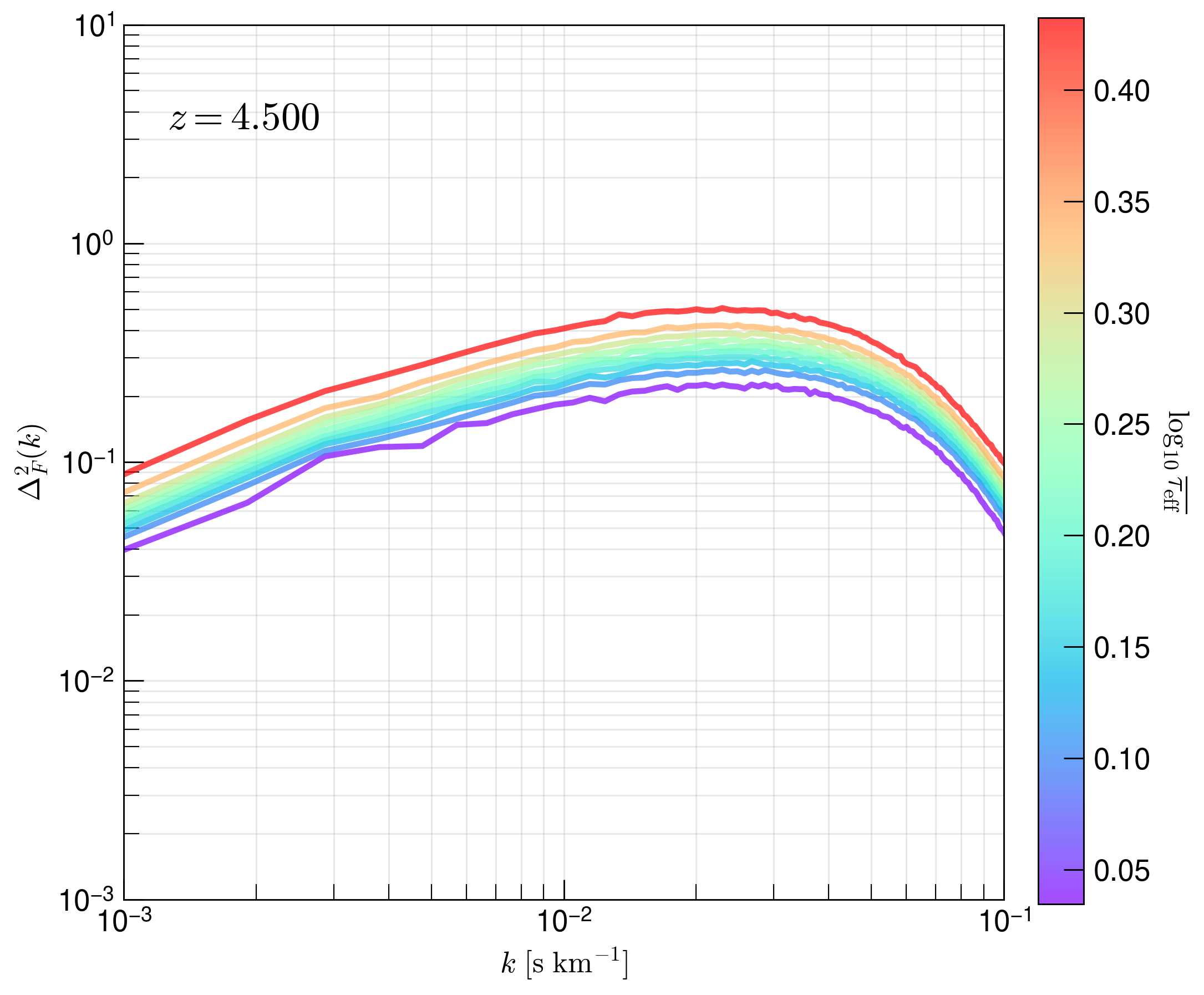
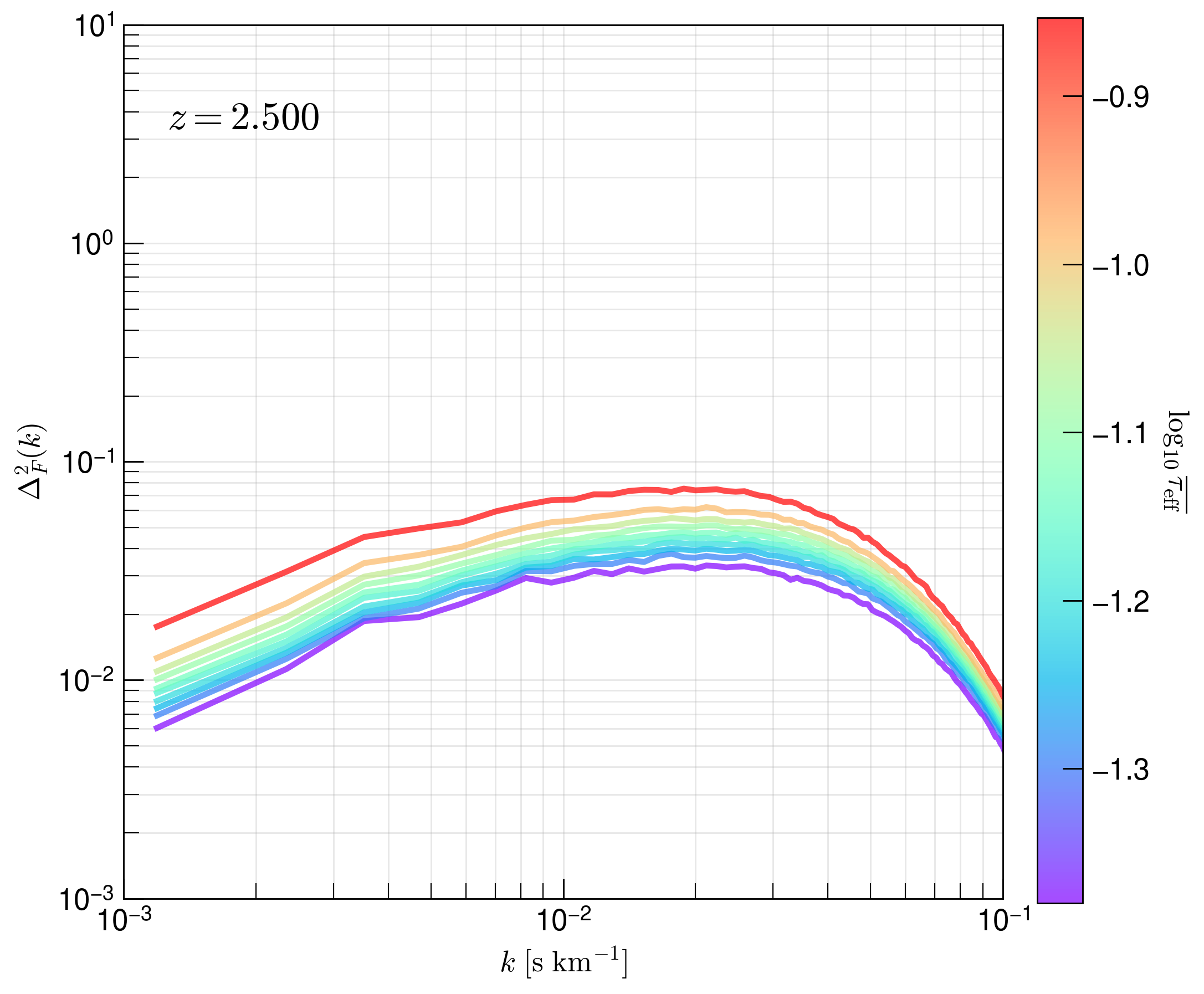
Simulation 2 Results – \(1024^3\) cells
We show the resulting plots at redshifts \(z=2.5, 4.5\)
Discussion
At a given redshift, there is more power at a given \(k\) mode when using skewers that have a larger effective optical depth. Grouping skewers that have a lower effective depth produces a flux power spectrum of less power. For the most optically thin regions, there are less deviations in the flux. As the Universe becomes more ionized in redshift, the optical depth of Lyman-alpha decreases, so we notice that the flux power spectrum dampens over redshifts.